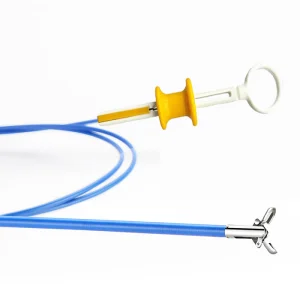
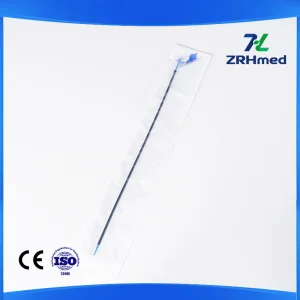
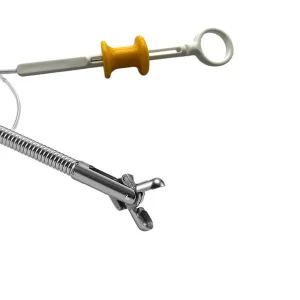
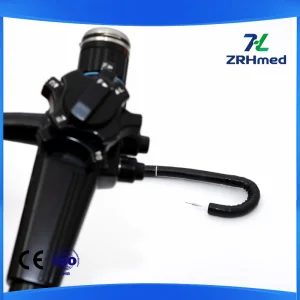
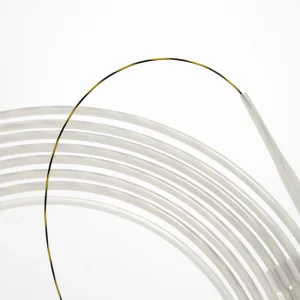
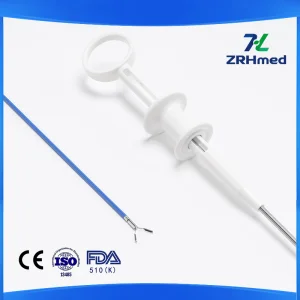
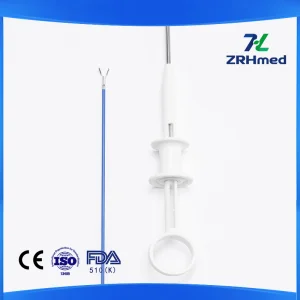
Browse our certified medical-grade single-use endoscopic instruments designed for optimal biopsy tissue yield, reliable electrosurgical hemostasis, and seamless passage through working channels.
Diagnostic colonoscopy remains the definitive gold standard for colorectal cancer (CRC) surveillance, inflammatory bowel disease (IBD) staging, and microscopic colitis detection. Behind every successful pathological diagnosis is a micro-engineered mechanical device: the colonoscopy biopsy forceps.
The historic transition from reusable instruments to single-use disposable biopsy forceps is driven by clinical infection-control mandates. Reusable biopsy forceps with internal braided pull-wires represent an extreme reprocessing liability, harbouring occult blood and biological debris in hard-to-clean lumen channels.
Gastroenterologists and pathologists demand pristine tissue architecture without crush artifacts, cellular fragmentation, or thermal distortion. State-of-the-art ODM manufacturing ensures clean incisive cuts through mucosal layers down to the muscularis mucosae.
Centralized purchasing organizations and regional ministries of health evaluate endoscopy consumables through overall procedural costs. Single-use forceps eliminate enzyme bath labor, reprocessing QA records, and channel friction damage to multi-million-dollar endoscopes.
A medical-grade biopsy forceps is a surgical micro-system operating inside tortuous anatomical environments. Every micron counts when passing through a fully retroflexed colonoscope positioned deep in the cecum or ascending colon.
Micro Metal Injection Molding (MIM) using surgical grade 17-4PH / 316L stainless steel allows intricate razor-sharp cup edges and balanced dual-pivot geometries for reliable shearing force.
Ultra-low coefficient of friction coating minimizes resistance during insertion through 2300mm colonoscopy channels, preventing micro-scratches on internal scope lining.
Precision laser-welded four-bar linkage mechanisms guarantee symmetrical opening and tight bite closure even when the colonoscope shaft undergoes severe looping.
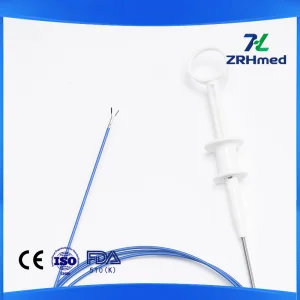
Tactile 3-ring handle delivers real-time haptic feedback to the endoscopist's fingers, registering precise tissue purchase and definite closure resistance without tactile delay.
| Forceps Category | Outer Diameter (OD) | Working Length | Working Channel Min. | Jaw Architecture & Features | Primary Clinical Target |
|---|---|---|---|---|---|
| Standard Colonoscopy Biopsy Forceps | 2.3 mm | 2300 mm | 2.8 mm | Oval Cup, Fenestrated, Optional Center Spike | Routine mucosal sampling, polyps < 5mm, IBD assessment |
| Jumbo / Max-Capacity Colon Forceps | 2.3 mm – 2.4 mm | 2300 mm | 2.8 mm – 3.2 mm | Deep-dish Oval, Lateral Fenestrations, Spike | Large tissue bite for suspected malignancy, sub-epithelial lesions |
| Gastroscopy Biopsy Forceps | 1.8 mm – 2.3 mm | 1600 mm – 1800 mm | 2.0 mm – 2.8 mm | Serrated Alligator Cup / Oval Cup | Gastric ulcer margins, H. pylori testing, Barrett's esophagus |
| Hot Biopsy Electrosurgical Forceps | 2.3 mm | 2300 mm | 2.8 mm | Insulated Sheath, Monopolar HF Connector, Oval Cup | Simultaneous tissue biopsy and coagulation hemostasis |
| Pediatric / Slim-Channel Forceps | 1.8 mm | 1800 mm – 2300 mm | 2.0 mm | Micro-Oval Cup, Ultra-flexible Coated Shaft | Pediatric colonoscopy, tortuous strictures, small-caliber scopes |
Modern Chinese medical device manufacturing has evolved from basic assembly to vertically integrated industrial clusters offering high precision, automated assembly, rapid prototyping, and unmatched cost-to-performance ratios.
By collocating raw wire drawing, spring coiling, sheath extrusion, precision injection molding, laser micro-welding, cleanroom assembly, and EO sterilization within a unified regional ecosystem, our manufacturing facilities eliminate tier-2 dependency delays.
We provide end-to-end original design manufacturing tailored to the brand identities and regulatory frameworks of multinational healthcare corporations and regional distributors across the EU, the Americas, APAC, and the Middle East.
Western healthcare reimbursement cuts demand significant savings on routine consumables. Our scalable manufacturing processes yield lower unit costs without sacrificing surgical performance, securing strong competitive margins in regional tenders.
Navigating medical device market entry requires comprehensive documentation, rigorous testing regimes, and strict adherence to international quality management standards.
Our quality management system governs every operational phase from product design and validation to raw material receipt, in-line process control, and post-market clinical follow-up (PMCF).
We provide complete Technical Documentation (TD) files conforming to European MDR Class IIa/IIb requirements, empowering regional importers to register SKUs smoothly with Notified Bodies.
Each batch undergoes Ethylene Oxide (EO) sterilization fully compliant with ISO 11135, verified via biological indicators (Bacillus atrophaeus) and residual EO/ECH headspace chromatography.
Matching instrument specifications to clinical scenarios optimizes sampling yield while lowering scope maintenance costs. Understanding these requirements helps procurement teams make data-backed purchasing decisions.
Clinical Context: Rapid identification and removal of diminutive polyps (≤ 5mm) in the sigmoid, transverse, and ascending colon.
Recommended Configuration: 2.3 mm outer diameter, 2300 mm working length, oval fenestrated cup with center spike to ensure secure grip on slippery, moving mucosal folds.
Distributor Advantage: High-velocity hospital inventory turnover with predictable monthly reorders.
Clinical Context: Multi-quadrant random and targeted biopsies in patients with long-standing Ulcerative Colitis or Crohn's Disease to assess dysplasia.
Recommended Configuration: Jumbo capacity oval cups (fenestrated) yielding clean, uncrushed tissue architecture containing full mucosal depth for histological grading.
Distributor Advantage: Premium positioning within tertiary university hospitals and pathology clinics.
Clinical Context: Diagnostic biopsy combined with simultaneous monopolar high-frequency coagulation to treat minor mucosal bleeding.
Recommended Configuration: High-dielectric insulated catheter jacket, HF gold-plated connector handle, tight-sealing metallic cups with controlled thermal diffusion.
Distributor Advantage: Higher margin per SKU with hospital tenders specifying dual-function therapeutic devices.
When evaluating ODM biopsy forceps suppliers, hospital procurement officers and medical distribution directors should systematically assess four key operational metrics:
Confirm clearance margins: A 2.3 mm forceps requires a ≥ 2.8 mm channel, allowing smooth passage through a retroflexed endoscope without binding.
Inspect microscopic cut consistency on test elastomer membranes to avoid mechanical tearing or specimen damage.
Require validated ISO 11135 sterilization records and residual EO reports (< 4 mg/device) for patient safety compliance.
Optimize cubic space utilization: 10 units per inner box, 100 to 200 units per master carton, maximizing air/ocean container load efficiency.
The landscape of GI diagnostics is evolving rapidly through the confluence of artificial intelligence, minimally invasive interventions, and environmentally responsible manufacturing practices.
Computer-Aided Diagnosis (CADe/CADx) systems detect adenomatous polyps in real time. Rather than replacing physical biopsies, AI highlights suspicious margins, requiring highly accurate biopsy forceps with centering spikes to target lesions under digital magnification.
Clinical evidence increasingly favors cold biopsy and cold snare resection for small polyps (< 5mm) to avoid post-polypectomy electrocoagulation syndrome and delayed bleeding. This transition increases demand for ultra-sharp mechanical forceps with high shear margins.
European and North American procurement directives are emphasizing the environmental impact of single-use medical devices. Leading factories are adopting bio-recyclable handle polymers, reduced Tyvek pouch thicknesses, and halogen-free sheath formulations.
Direct answers to technical, commercial, and regulatory questions commonly raised by medical device importers and distributor purchasing teams.
For standard private-label configurations (custom box artwork, sterile blister pouch printing, laser logo marking), lead times typically range from 20 to 30 days after artwork and technical specification sign-off. Repeat bulk orders can be shipped within 14 days under structured forecast agreements.
The primary distinction is working length. Gastroscopy forceps require a working length of 1600 mm to 1800 mm, while colonoscopy forceps require 2300 mm to navigate the adult colon. Outer diameters for both typically measure 2.3 mm, compatible with standard 2.8 mm endoscope working channels.
We employ a proprietary stranded, high-tensile core pull-wire coupled with an internal spring-tube reinforcement and external lubricious PTFE jacket. This multi-layered construction delivers consistent mechanical transmission without binding, even in extreme retroflexion angles up to 210 degrees.
We provide complete dossiers including ISO 13485 certification, CE Declaration of Conformity, full biocompatibility test reports (ISO 10993), accelerated aging and transit challenge data (ASTM D4169), and EO residual verification records.
Fenestrated cups feature micro-machined side openings that allow tissue to expand into the cup cavity during closure. This increases specimen volume, prevents tissue compression artifacts, and facilitates easy sample retrieval for lab placement.
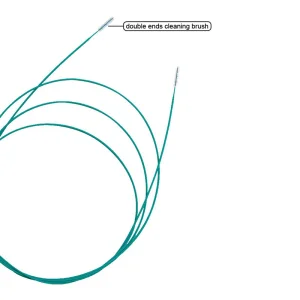
Yes. Global distributors frequently bundle biopsy forceps with complementary single-use consumables—such as endoscopic hemoclips, polypectomy snares, injection needles, ERCP guidewires, and cytology brushes—in a single consolidated container shipment to optimize freight and customs clearance.
Expand your hospital catalog with our single-source manufacturing capabilities covering hemostasis clips, stone access sheaths, spray catheters, and ERCP instrumentation.