Explore our certified medical-grade disposables manufactured under ISO 13485 conditions for international healthcare tenders and medical device distributors.
Mitigating intrarenal pressure elevation during high-flow laser lithotripsy through active fluid evacuation.
Standard flexible ureteroscopy (f-URS) often elevates pyelovenous backflow thresholds beyond 30 mmHg, driving postoperative pyrexia, bacteremia, and sepsis. Our vacuum-regulated sheath creates a controlled hydraulic balance, preserving baseline pressures between 10–20 mmHg even under forced continuous saline irrigation.
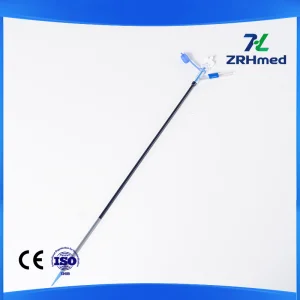
By coupling an oblique suction port directly adjacent to the endoscope entrance channel, the sheath leverages the Venturi-vortex dynamic. Stone fragments pulverized via Holmium or Thulium Fiber Laser (TFL) are instantly evacuated through the coaxial gap without repetitive basket basket extraction.
High-frequency laser ablation rapidly heats localized caliceal fluid, introducing risk of ureteral stricture and parenchymal thermal necrosis. The integrated negative-pressure convective circuit accelerates thermal clearance, maintaining renal pelvic fluid temperatures consistently under 42°C.
Addressing clinical throughput, complication management, and healthcare reimbursement burdens worldwide.
Hospital re-admissions attributed to urosepsis present immense costs to tertiary clinics. Regulated suction channels purge bacteremia-laden purulent fluid and calculi dust in real time, demonstrating in clinical trials a profound reduction in post-procedural systemic inflammatory response syndrome (SIRS).
Eliminating endless stone-basket deployment passes cuts surgical theater duration by an average of 25–40%. Surgeons achieve complete "dust and clear" maneuvers simultaneously, elevating operating department capacity and hospital procedural revenue per OR session.
Residual fragments (>2 mm) frequently lead to recurrent nephrolithiasis and second-look interventions. Continuous negative evacuation cleanses both inter-caliceal cavities and the lower pole, significantly bolstering first-stage Stone-Free Rates (SFR) verified on postoperative CT scans.
Combining robotic extrusion, multi-axis braiding, and automated cleanroom logistics to insulate medical distributors from supply volatility.
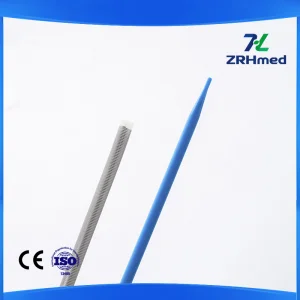
Our continuous coil-braid composite technology incorporates surgical-grade 304V stainless steel and shape-memory nitinol ribboning. This delivers 1:1 torque transmission, extreme kink resistance, and a minimal wall profile that expands functional internal lumen space without increasing outer French diameters.
Proprietary UV-curable crosslinked hydrophilic coating is applied across the outer sheath sheath body. Slurry immersion testing validates ultra-low friction coefficients (μ < 0.02) during ureteral intubation, effectively preventing tissue friction, mucosal stripping, and false lumen formation during anatomical tracking.
From initial fluoropolymer pellet compounding through laser welding, automated visual dimensional verification, ethylene oxide (EO) sterilization, and blister sealing, every phase occurs within our Jiangxi manufacturing compound, guaranteeing raw material trace-forward and recall safety.
Pioneering sensorized access platforms, active peristaltic suction manifolds, and bendable smart distal deflectors.
Upcoming product iterations embed micro-electromechanical pressure transducers directly on the distal sheath tip. This sensor infrastructure bridges data wirelessly to closed-loop irrigation pumps, automatically tuning vacuum and inflow rates to throttle pressures dynamically below programmed clinical thresholds.
Transitioning from static conduits to omnidirectional steerable tips. Integrating pull-wire articulation allows the tip of the access sheath to articulate actively into difficult acute-angled lower calyces, allowing the flexible ureteroscope to remain unflexed, drastically prolonging scope longevity.
Collaborating with polymer laboratories to incorporate bio-inert recyclable thermoplastics without compromising tensile or burst pressures. The initiative cuts single-use clinical medical waste in compliance with progressive hospital green-procurement mandates.
A rigorous regulatory dossier engineered to expedite market authorization across Europe, the Americas, and APAC territories.
Full technical documentation and CER (Clinical Evaluation Reports) verified by EU Notified Bodies, ensuring frictionless customs clearance and hospital tender qualification across the European Union.
Complete multi-batch toxicological assessments covering cytotoxicity, systemic toxicity, intracutaneous reactivity, sensitization, and hemocompatibility, verifying zero adverse physiological responses.
Complete customization encompassing bespoke color hubs, laser etched scale graduations, customized French dimensional variations (10/12Fr, 11/13Fr, 12/14Fr), and multilingual sterilized packaging.
Direct contract inventory allocations with bonded warehousing solutions. We safeguard international distributors against delivery shocks with safety buffer stocks for long-term contract reliability.
Key information covering clinical operation, vacuum controls, sizing configurations, and international registration support.
Standard ureteral sheaths provide a passive egress path around the outside of the endoscope. When high irrigation pressure is applied or if the lumen is packed with stone debris, fluid outflow is choked, rapidly driving intrarenal pressure past the critical threshold of 30 mmHg. The suction ureteral access sheath features an active side port with an adjustable vacuum valve. This creates continuous or pulsatile aspiration that systematically evacuates irrigation fluid and micro-fragments, keeping caliceal pressure safe, maintaining optical visibility, and preventing fluid extravasation into the renal parenchyma.
Our standard clinical portfolio offers internal/external diameters of 10/12 Fr, 11/13 Fr, 12/14 Fr, and 13/15 Fr with usable working lengths of 15 cm, 25 cm, 35 cm, 45 cm, and 55 cm. Custom outer diameters, transition tapering profiles, and dual-lumen extrusion configurations can be tailored through our rapid OEM prototyping line based on specific distributor tender requirements.
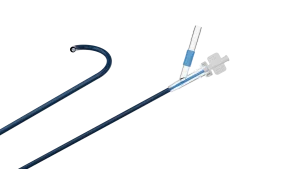
The sheath interface features a universal barbed connector with an integrated Luer lock fitting, allowing direct connection to hospital central vacuum pipeline systems or standalone medical surgical aspirators. Optimal aspiration is achieved at negative pressures between -15 kPa and -35 kPa, regulated by the surgeon via a thumb-controlled venting port or an external foot-pedal regulator valve.
Kink resistance is confirmed using ASTM F2528 and ISO 10555 bench testing protocols. Utilizing a high-tensile 304V stainless steel coil-and-braid mesh within the mid-layer, the sheath resists ovalization and collapse even under a bend radius as tight as 10 mm. This structure allows the continuous passage of both digital and fiberoptic flexible ureteroscopes without binding.
We supply a turnkey regulatory dossier including ISO 13485:2016 factory audit documentation, full technical files conforming to the European Medical Device Regulation (MDR 2017/745), ISO 10993 biocompatibility testing matrices, packaging transit validation reports (ASTM D4169), and EO residual gas analysis (ISO 11135), accelerating regional market entry.
Review our surgical-grade consumables engineered for seamless cross-specialty clinical performance in GI and Urology suites.