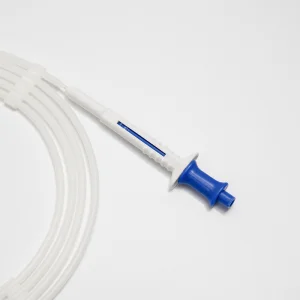
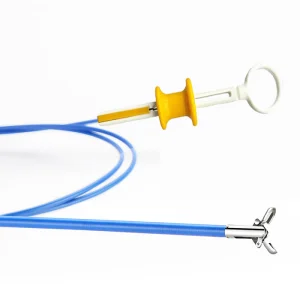
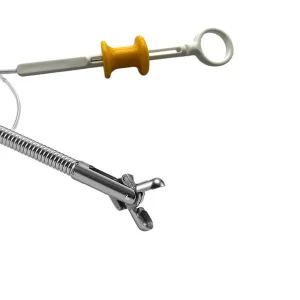
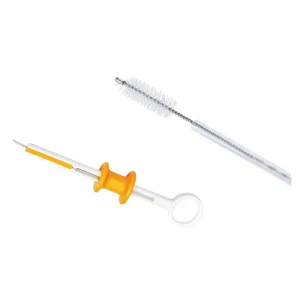
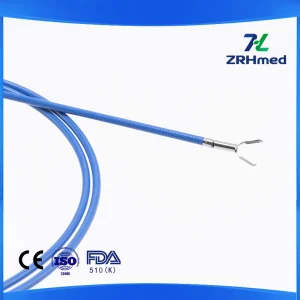
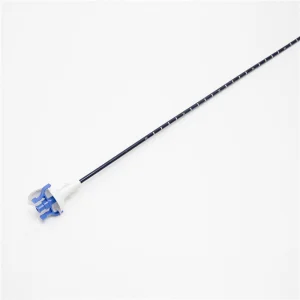
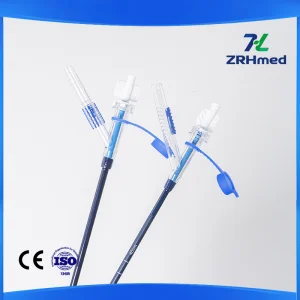
Manufactured under verified Class 100,000 cleanroom protocols with complete traceability and cross-system compatibility.
How advanced endoscopic clip design minimizes post-polypectomy complications, eliminates secondary bleeding, and closes full-thickness iatrogenic perforations during lower GI interventions.
Prophylactic clipping following Endoscopic Mucosal Resection (EMR) and large polyp cold snare polypectomy (CSP) reduces delayed bleeding rates from 8.6% to under 0.8% in lesions greater than 20mm. An ODM clip supplier must ensure exceptional tensile clamping force to secure arterial vessels traversing the submucosa without shearing surrounding fragile mucosal borders.
Full-thickness perforations occurring during complex Endoscopic Submucosal Dissection (ESD) demand immediate endoscopic closure to prevent emergency laparotomy and fecal peritonitis. High-span ODM hemoclips with jaw openings from 11mm to 16mm deliver precise tissue approximation, facilitating primary intention healing and tissue regeneration across the muscularis propria.
During colonoscopy navigation through the sigmoid colon and splenic flexure, endoscopes encounter acute deflection angles exceeding 150 degrees. Inferior catheters buckle under retroflexion, locking the internal pull wire. Our factory-engineered dual-wound flat stainless wire sheaths maintain absolute 1:1 torque responsiveness and negligible axial friction, regardless of scope curvature.
Addressing hospital group tender requirements, OEM branding localization, and risk mitigation strategies for medical distribution networks.
Global medical supply channels are constrained by legacy Tier-1 OEMs charging steep distribution premiums ($45 to $85 per hemoclip cartridge). Hospital procurement committees under DRG (Diagnosis-Related Group) reimbursement models are actively enforcing spending caps on consumable surgical accessories. Partnering directly with an established ODM factory allows distributors to capture sustainable 45% to 65% gross margins while delivering hospital tender pricing below $18 per sterile unit without sacrificing metallurgical reliability or clinical tactile response.
A failed hemoclip deployment during active arterial spurting triggers significant blood transfusion requirements, extended procedure times, and potential liability. Common failure modes in cheap commodity clips include jaw slippage, premature lock, inability to rotate in tortuous anatomies, and sheath kink deformation. Our ODM manufacturing infrastructure enforces 100% automated optical inspection (AOI) on jaw chamfers, tensile fracture testing on control cables, and micro-welding integrity audits to achieve a defective release rate lower than 0.003%.
| Evaluation Parameter | Legacy Tier-1 Japanese/US Brands | Generic Commodity Factories | ZhuoRuiHua ODM Certified Platform |
|---|---|---|---|
| Cartridge Unit Cost | $40.00 – $85.00 | $4.50 – $7.00 | $8.00 – $14.50 (Direct OEM Volume) |
| Tactile Synchronous Rotation | 1:1 Precise (Proprietary) | High lag, binding in retroflexion | 1:1 Dual-Wound Anti-Twist Control |
| Jaw Retention Clamping Force | > 7.5 N | < 4.0 N (Risk of premature detachment) | ≥ 8.5 N (Continuous Spring Lock) |
| Repositionable Re-Opening | Yes (Up to 5–10 times) | Single-fire or plastic latch fatigue | Yes (≥ 10 Full Stroke Cycles) |
| Regulatory Dossiers (MDR/FDA) | Complete global clearances | Fragmented or regional only | ISO 13485, CE (MDR Class IIb), FDA 510(k) Ready |
| Private Label Packaging Customization | Unavailable (Standard corporate SKU) | Rudimentary over-labeling | Turnkey sterile blister, IFU, UDI barcode print |
From metallurgical wire extrusion to intelligent robotic-assisted tissue marking: the technical anatomy of modern colonoscopic clips.
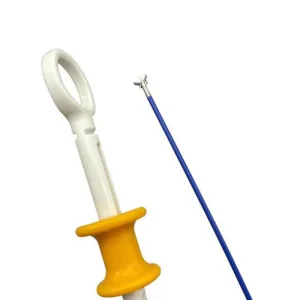
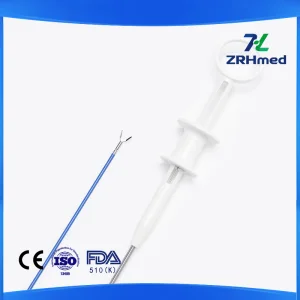
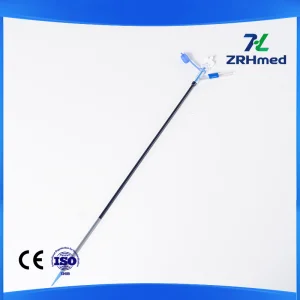
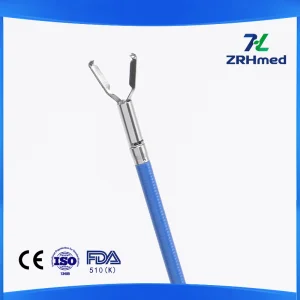
Our clip jaws are stamped and EDM-machined from precipitation-hardened 17-7PH medical stainless steel and surgical 304V spring alloys. This composition provides superior modulus of elasticity and tensile yield limits, preventing jaw deformation under high lateral shear stress. For ultra-wide span configurations (16mm), specialized superelastic Nitinol cross-bars are integrated to preserve elastic recovery after sustained compression within 2.8mm biopsy channels.
The distal release hub employs a calibrated fracture-pin or breakaway J-hook linkage. When the endoscopist confirms optimal tissue grasp, retraction of the handle slider past the mechanical resistance barrier triggers an unmistakable audible and tactile "snap" at 28–32 N handle pull force. The clip secures autonomously, leaving a low-profile capsule stub (under 4.5mm) that prevents inadvertent abrasion of opposing luminal bowel walls.
The 2026–2030 technology roadmap focuses on magnesium alloy bioresorbable clips engineered to retain full mechanical tissue grip for 14 to 21 days before hydrolyzing benignly into standard biological minerals, eliminating risks of foreign body retention. Concurrently, factory R&D is completing prototypes with radiopaque micro-gold fiducial markers for automated computer vision detection during AI-assisted surveillance colonoscopy.
Stringent compliance with global medical device standards ensures seamless registration and market authorization across EMEA, the Americas, and APAC.
Our manufacturing plant features 5,500 square meters of certified ISO Class 8 (100,000) cleanroom environments equipped with positive pressure differential controls, automated ultrasonic degreasing, and Class 10,000 laminar flow assembly hoods for critical clip-to-sheath micro-pin bonding.
Full support for notified body audits under EU MDR. We deliver complete Technical Documentation dossiers, Risk Management Files (ISO 14971), Usability Engineering Files (IEC 62366), and comprehensive Clinical Evaluation Reports (CER) per MEDDEV 2.7/1 Rev 4 guidelines.
Every clip line undergoes exhaustive ISO 10993 cytotoxicity, sensitization, systemic toxicity, and hemocompatibility testing. Sterilization cycles are strictly validated under ISO 11135 to ensure an overkill Sterility Assurance Level (SAL) of 10-6 with EO residuals well below 4 μg/g.
Comprehensive engineering specifications matching global clinical requirements for colonoscopes, gastroscopes, and duodenoscopes.
| Model Classification | Working Channel Min. | Working Length | Jaw Opening Span | Rotation Capability | Repositionable Limit | Primary Clinical Application |
|---|---|---|---|---|---|---|
| ZRH-HC-09-1950 | Ø 2.8 mm | 1950 mm / 2300 mm | 9.0 mm | 360° Bidirectional | > 10 Cycles | Standard upper GI bleed, Dieulafoy lesion, micro-polyp defect |
| ZRH-HC-11-2300 | Ø 2.8 mm | 2300 mm | 11.0 mm | 360° Bidirectional | > 10 Cycles | Post-polypectomy cold snare defect, diverticular bleeding |
| ZRH-HC-13-2300 (Wide) | Ø 2.8 mm / 3.2 mm | 2300 mm | 13.5 mm | 360° Bidirectional | > 8 Cycles | EMR mucosal defect closure, large colonic resection sites |
| ZRH-HC-16-2300 (Mega) | Ø 3.2 mm / 3.7 mm | 2300 mm | 16.0 mm | 360° Bidirectional | > 6 Cycles | Full-thickness colon perforation, deep muscular defect repair |
Detailed technical, regulatory, and supply chain insights for hospital purchasers, tender managers, and private-label distributors.
Streamline your hospital vendor roster with our vertically integrated diagnostic, resection, and biliary product families.