
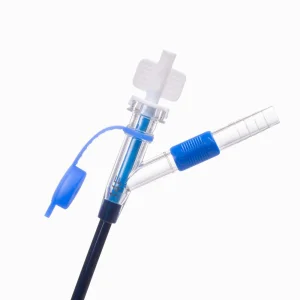
CE Certification Low Intrarenal Pressure Suction UAS Disposable Ureteral Access Sheath with Negative Pressure for Sepsis Prevention Supplier, Factories
View Product Specs
Precision-manufactured urology sheaths and therapeutic endoscopy consumables meeting CE Class IIa, ISO 13485, and international clinical safety standards.
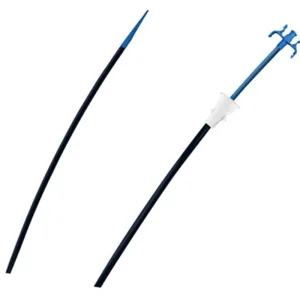
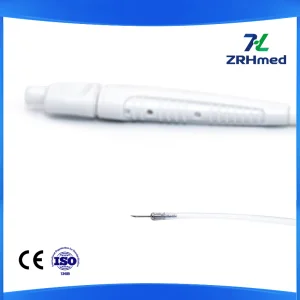
Evaluating intrarenal hemodynamics, pyelovenous backflow prevention, and continuous thermal dissipation in modern laser lithotripsy protocols.
Flexible Ureteroscopy (fURS) and Retrograde Intrarenal Surgery (RIRS) have fundamentally revolutionized the management of upper urinary tract urolithiasis over the past two decades. However, the rapid clinical adoption of high-power pulsed Holmium:YAG (Ho:YAG) lasers (up to 120W) and superpulsed Thulium Fiber Lasers (TFL) has exposed critical physiological limitations in conventional, passive-dilation ureteral access sheaths. In standard retrograde interventions without active suction, continuous pressurized fluid irrigation is required to preserve optical clarity and clear microscopic blood or stone debris. When continuous fluid influx outpaces the passive drainage capacity of the ureteral lumen, Intrarenal Pressure (IRP) routinely surges beyond physiological thresholds.
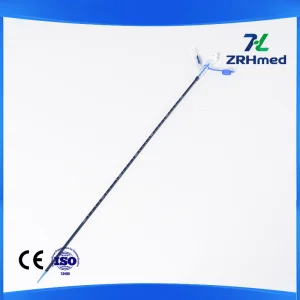
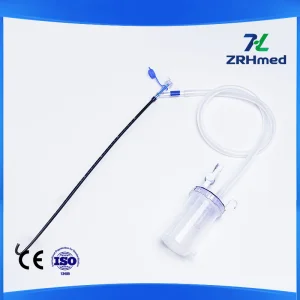
As an established OEM Ureteral Access Sheath with Suction manufacturer, Jiangxi ZhuoRuiHua Medical Instrument Co., Ltd. (ZRH Med) re-engineers this hydrodynamic dynamic. By integrating an active vacuum-regulated bypass lumen directly into the proximal hub and co-axial sheath wall, our suction UAS platform transforms an open, uncontrolled pressurized renal cavity into a balanced, closed-loop fluid circuit. Continuous or controlled pulse aspiration maintains real-time intrapelvic pressures stably below 20 mmHg—even under forced irrigation rates exceeding 40 to 60 mL/min.
| Biomechanical / Clinical Metric | Standard Conventional UAS (Passive) | ZRH Med Suction-Assisted UAS (Negative Pressure) | Clinical Significance & Outcome Gain |
|---|---|---|---|
| Intrarenal Pressure (IRP) Profile | Unregulated spikes (40 – 90+ mmHg) during forced flushing | Controlled steady negative state (< 20 mmHg) | Eliminates pyelovenous reflux, reducing SIRS incidence by up to 74% |
| Thermal Energy Dissipation | Heat accumulation from continuous laser firing (> 48°C) | Continuous rapid fluid turnover evacuates thermal plumes | Prevents pelvicalyceal urothelial denudation and thermal necrosis |
| Stone Clearance Mechanism | Manual nitinol basket extraction; repetitive scope passes | Vortex suction evacuation of dust & fragments < 2.5 mm | Reduces operative time by 35–45%; reaches higher Stone-Free Rates (SFR) |
| Optical Field Visibility | Frequent snowstorm effect from floating dust and micro-bleeding | Instant aspiration of visual contaminants at lithotripsy site | Maintains pristine digital scope clarity; eliminates blind laser firing |
| Ureteral Wall Mucosal Shear | High friction during multiple re-insertions of flexible scope | Sheath stays stationary; scopes pass through ultra-smooth PTFE | Minimizes post-op ureteral stricture and ischemic mucosal damage |
Engineered for extreme kink resistance, optimal inner-to-outer diameter ratios, and frictionless scope navigation.
The structural integrity of our ureteral access sheaths relies on an ultra-thin three-layer composite extrusion engineered to maximize lumen area while preserving strict dimensional tolerances.
To protect delicate ureteral urothelium from avulsion and mucosal shearing during introduction through tight ureterovesical junctions (UVJ), our sheaths undergo specialized surface modification.
The proprietary suction manifold features an ergonomic Y-junction connector equipped with a fingertip vent-port or regulated dial for real-time surgical vacuum calibration.
How vertical integration, precision tooling, and centralized medical device clusters deliver unmatched speed, cost advantage, and regulatory stability for international OEM brand owners.
The global market for ureteral access sheaths and stone management consumables has experienced accelerated expansion, forecasted to exceed USD 1.8 billion by 2030. This surge is driven by escalating urolithiasis prevalence worldwide, the rapid transition from shockwave lithotripsy (ESWL) to outpatient endoscopic dusting, and rising hospital mandates to curb septic readmissions. Traditionally, European and American tier-one medical device corporations dominated the supply chain; however, their capital-heavy operational footprints and layered contract manufacturing markups impose prohibitive price tags on single-use consumables—imposing acute fiscal stress on national healthcare reimbursement systems and competitive tender distributors.
Situated in Jiangxi’s dedicated high-tech medical instrument industrial corridor, Jiangxi ZhuoRuiHua Medical Instrument Co., Ltd. operates state-of-the-art Class 10,000 (ISO 7) and Class 100,000 (ISO 8) cleanroom facilities. Unlike assemblers who outsource tubing and catheter tips to fragmented third parties, ZRH Med controls every critical juncture in-house:
Multi-lumen extrusion lines producing ultra-thin catheter walls with ±0.015 mm dimensional tolerance, guaranteeing seamless dilator matching.
CNC multi-axis braiding machines wrapping flat stainless steel and superelastic nitinol filaments with customizable variable-pitch tension.
On-site automated ethylene oxide (EtO) sterilization vessels adhering strictly to ISO 11135 validation, securing residual limits < 4 µg/g.
This concentrated ecosystem compresses OEM development timelines from concept to pilot batch down to just 8 to 12 weeks, compared to typical 9 to 14 months seen with European contract manufacturers. Furthermore, our direct factory footprint grants overseas distribution partners a direct 35% to 55% BOM cost reduction, creating commanding competitive bidding margins in government tenders across Europe, Latin America, Southeast Asia, and the Middle East.
Detailed procedural adaptability across flexible ureteroscopy, mini-percutaneous nephrolithotomy (Mini-PCNL), and complex staghorn calculi ablation.
When treating caliceal or renal pelvis stones > 15 mm using high-frequency Thulium Fiber Laser (TFL) or Holmium dusting settings (e.g., 0.2–0.4 J @ 40–80 Hz), pulverized gravel generates dense particulate clouds. Suction UAS continuously sweeps away microscopic dust particles, precluding retropulsion into obscure calyces and yielding immediate visual confirmation of stone bed margins.
Patients presenting with struvite stones, pre-existing pyelonephritis, or solitary functional kidneys represent hyper-vulnerable cohorts. Utilizing negative-pressure aspiration maintains the renal pelvis in a consistently non-distended state, minimizing transmural bacterial leakage across mucosal barriers and preventing irreversible septic compromise.
In Endoscopic Combined Intrarenal Surgery (ECIRS), a suction ureteral access sheath is paired retrogradely with antegrade percutaneous nephroscopy. This establishes an ultra-efficient dual-direction flushing system: antegrade irrigation fluids are rapidly drawn out through the retrograde suction sheath, achieving comprehensive clearance of multi-caliceal staghorn stones without pelvic hypertension.
| Inner / Outer Diameter (French) | Available Lengths (cm) | Endoscope Compatibility | Recommended Clinical Indications |
|---|---|---|---|
| 10 / 12 Fr | 28 cm, 35 cm, 45 cm | Slim digital fURS (≤ 7.5 Fr outer diameter) | Pediatric patients, virgin ureters, tight UVJ, diagnostic ureteroscopy |
| 11 / 13 Fr | 35 cm, 45 cm, 50 cm | Standard digital & fiberoptic fURS (7.5 – 8.5 Fr) | The universal gold standard: optimal balance between drainage lumen & ureteral dilation |
| 12 / 14 Fr | 35 cm, 45 cm, 55 cm | Standard & large-channel fURS (8.5 – 9.5 Fr) | High stone burdens (> 2 cm), rapid evacuation of large fragments, ECIRS |
| 14 / 16 Fr | 20 cm, 28 cm, 35 cm | Rigid & semi-rigid ureteroscopes, mini-nephroscopes | Distal/mid ureteral impacted calculi, antegrade mini-PCNL access channels |
From intelligent pressure-sensing sheaths to steerable navigable distal tips: how ZRH Med powers next-generation medical device brands.
The endourology ecosystem is moving inexorably toward smart, interconnected, and sensor-augmented instrumentation. At ZRH Med, our urological R&D engineering division is actively spearheading two transformational product generations:
Traditional UAS are rigid-axial and terminate in the proximal ureter or renal pelvis. Our next-generation FANS devices incorporate an actively deflectable distal tip controllable from the handpiece. This allows surgeons to guide the suction tip directly into difficult lower-pole calices, vacuuming trapped stone sludge directly at the laser target without relying on risky basket maneuvers.
By embedding sub-millimeter fiber-optic or piezo-resistive MEMS pressure sensors into the sheath’s distal tip, our engineering team is establishing real-time feedback with automatic hospital vacuum regulators. When intrapelvic pressure approaches 25 mmHg, the system modulates suction flow dynamically, eliminating human error.
ZRH Med serves as the premier contract manufacturing engine for global medical distributors, private labelers, and tier-one medical brands. Our comprehensive OEM/ODM service suite includes:
Key technical, regulatory, and commercial clarifications regarding negative-pressure ureteral access sheaths and factory OEM partnerships.
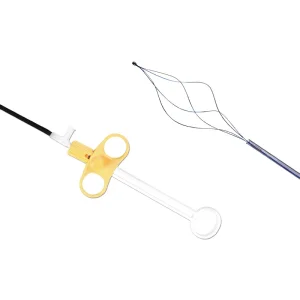
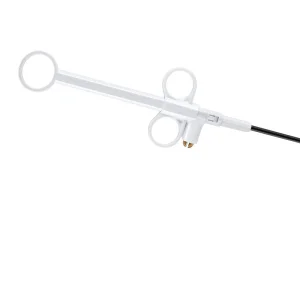
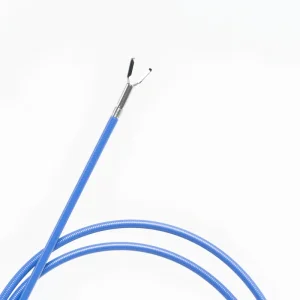
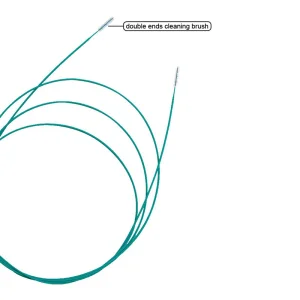
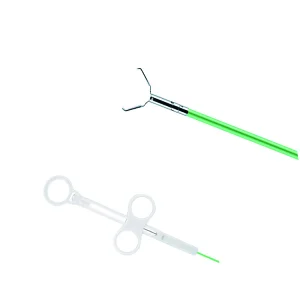
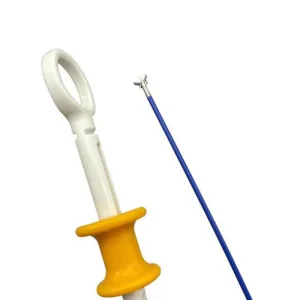
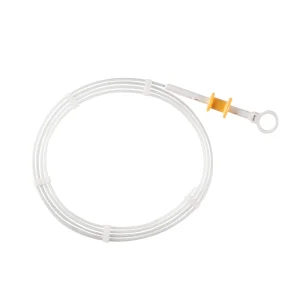
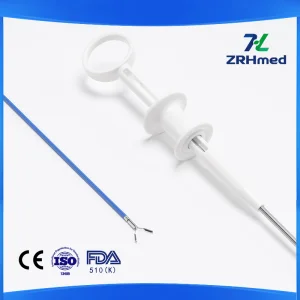
Expanding clinical versatility: single-use biopsy, mechanical hemostasis clips, chromoendoscopy spray catheters, and decontamination instruments manufactured in Jiangxi, China.
Accelerate your market penetration with CE-certified, low intrarenal pressure ureteral access sheaths. Request sample evaluation kits, full technical dossiers, or custom private-label price quotations from our engineering leadership.